Writers of series are often victims of their own success. They lay down the lines of their lead characters in the first book or two, and are then confined within those borders, not merely by rules of logic (“You said he had only two brothers”) but also because series readers can get very testy if a writer tries to change things up.
Reginald Hill, astonishingly, managed to escape the trap. With each book in the “Dalziel and Pascoe” series, he expanded both his characters’ characters and his own writerly paint-box. He said once that he had resolved early on to treat the series as a sort of scaffolding on which he could hang all the various kinds of novels he wanted to write – espionage, science fiction, historicals, etc. And it’s really with An April Shroud that this experiment began.
The first twist comes up front, with the focus on Andy Dalziel. Who on earth would make Dalziel a protagonist? He’s a rude, fat, balding bigot, hardly the kind of fellow with whom readers want to identify (and yet Hill’s talent is such that by the end of the book, you may well have changed your tune). Then there’s the setting: the classic English manor house, stuffed with a motley assortment of suspects- and victims-to-be. Who on earth would take that kind of setting, with its preciously crafted conventions, its dinner jackets and vicars and flighty ingénues, and set Andy Dalziel in the middle of things, the proverbial bull in a china shop?
Hill, apparently: With An April Shroud he created the improbable love-child of the traditional, Golden-Age country-house murder mystery and the tougher, edgier, more realistic cop drama (“police procedural” is the industry term) for which he was becoming known.
I use “love” advisedly, because onto this astonishing minotaur of a novel, Hill grafted a third genre: Romance. One could almost imagine Peter Pascoe as a romantic hero – young, fit, well educated — but instead, Hill sent Cupid to strike at Andy Dalziel’s aging, flabby heart. Dalziel! Who on earth would want to heave that bulk into bed? Ah, and yet again, by the end of the book, you may well have changed your tune. As a pure technical tour de force, An April Shroud is a marvel. But as a character study, a portrait of a man we thought we knew, it’s a joy. And it’s also – rather rare among mysteries – genuinely uplifting. If the dreadful, sweaty Andy Dalziel can find love, if he can command love from the reader, well then, perhaps even the sweatiest among us has grounds for hope.
Find out More
PAPERBACK [ $14.95 $10.95 ]
Add to Stack
Funny mysteries. It’s a genre that many have tried, but few have conquered. The Felony & Mayhem list contains some of the gems of the genre – off the top of my head: Unorthodox Practices, by Marissa Peisman; Unnatural Fire, by Fidelis Morgan; The Herring-Sellers’ Apprentice, by LC Tyler, just about anything by Caroline Graham – but the true master of the snickering snee, so far as I’m concerned, is Robert Barnard. His gleeful, dyspeptic evisceration of “theatricals” in Death and the Chaste Apprentice and Death on the High C’s makes me wheeze with laughter, even on the sixth or seventh reading. And yet, when he turns his pen to more serious stories, as in Out of the Blackout or Skeleton in the Grass, there are few writers who can touch him for nuanced characterization and a specific, incredibly evocative sense of place and time.
So why aren’t we highlighting any of these books? Because Corpse in a Gilded Cage, to my mind, combines the best of all of them. The story, about a Cockney family that inherits an earldom (and the drafty manor house that goes with it) is as deliciously funny as one could possibly desire, but the characterizations – even when they are perfectly embodying “stuffy” or “crass” or “vulgar as a dirty joke in church” – are stunning. I’m particularly fond of the new Earl and his lady (both of whom would much rather be back in their crummy old flat), but Phil, the son and heir (only recently released from Her Majesty’s penal system) is a delightful piece of work. He’ll do you out of your wallet in such charming style that you’ll thank him for doing it and offer him your watch.
I promised a book that would touch on the theme of fresh starts, and a fresh start complete with 27 bedrooms and live-in staff strikes me as the very finest kind. Of course, it isn’t all tea and crumpets, but we’re mystery fans here: Would we want it any other way?
Find out More
PAPERBACK [ $14.95 $10.95 ]
Add to Stack
If I could, I’d send all of you a tall glass of something cold, but failing that, I figured we should discount a book that would whisk you away to a place where hot-and-sticky isn’t even a recent memory. To be honest, the best “chill you out” book I can think of is The Wolves of Willoughby Chase, a spectacularly wonderful children’s classic with scenes – indelibly printed on my memory – of a train puffing frantically across a snow-covered landscape as packs of howling wolves come ever closer, and Sylvia, shivering in her thin white dress, watches in terror as her companion breaks the window and takes aim at the ravenous brutes with his blunderbuss….
But we don’t publish Willoughby Chase, so I can’t offer you a discount. Instead I’m going to recommend the extraordinary Missing, by Karin Alvtegen. Now, I wouldn’t lie, but just in case you were skeptical, I’m not the only person who finds this book extraordinary. It won the Glass Key award, given annually for the best “Nordic” crime novel, and in 2008 our edition was shortlisted for an Edgar award for best crime novel of the year. The reviews, both here and overseas, have been stunning – the Brits, for example, have likened Alvtegen to “Ruth Rendell at her very best,” while more than one U.S. blogger has compared Missing (favorably) to The Girl with the Dragon Tattoo – and the Swedish press has dubbed Alvtegen the country’s “Queen of Crime.”
But will it raise a chill? Oh yes. The heroine is Sybilla, who has spent the past 18 years homeless, on the icy streets of Stockholm, craving anonymity more than warmth, more than safety, more than a bed. And indeed, when she yields, briefly, to the lure of a warm bed, she invites catastrophe: A murdered man and Sybilla’s face, on the front page of every paper, as the chief suspect. Desperate to regain invisibility, her only hope lies in tracking down the murderer. It’s a story of ice, in more ways than one. And in Sybilla’s quest to lose herself, to find her home in….in homelessness, is provides one of the most interesting motivations I’ve ever come across.
An interesting factoid? As published in Swedish, and then in translation in the UK, the book opens with a semi-religious rant in the mind of the killer. This is followed by a terrific scene involving a scam Sybilla is running at a fancy hotel. When we were getting ready to print our edition, I got in touch with the author, and told her I wanted to switch the order of those two scenes; I thought the scene in the hotel made for a much stronger opener. She consented to the change, and I like to think that the switch played some role in the book’s earning an Edgar nomination.
Incidentally, if any of you are collectors, we do have signed first-edition hardcovers of Missing, as well as the paperbacks. While the British edition was the true first, our hardcovers are the only signed editions of any of Alvtegen’s books, and they differ from the UK edition with respect to the switch discussed above.
Find out More
PAPERBACK [ $14.95 $10.95 ]
Add to Stack
I was reading an article the other day about the TV show “House.” It seems the network was initially very leery about putting the show on the air. Why? Well, the protagonist is cranky, arrogant, sexist, rude…not, in other words, a very nice fella. And Americans, or so the thinking went, demand nice fellas.
Apparently, not so much. “House,” of course, went on to become hugely, insanely popular, both in America and around the world. It’s also very popular in my apartment, partly because I have a crush on Robert Sean Leonard, and partly because, at least when it comes to fiction, I rather like arrogant jerks.
Which brings me The Bad News Bible, the first in one of my very favorite series. As always, it was the writing that grabbed me first; I am such a sucker for a vivid narrative voice, one that rings in my head with the clarity of a church bell (though not, perhaps, at a church where I’d want to worship). But once that prose style had lured me in, I fell – hard – for Faith Zanetti, the woman your mother warned you about. Faith curses like a sailor, drinks like a Scotsman on a spree, and sleeps around like she was getting paid for it. She isn’t, but that’s among the few sins she doesn’t commit, since one of the big perks of her life as a war correspondent is that sniper fire has a nifty way of killing off minor moralities.
Remember Jane Tennison, the magnificently messed-up heroine of the “Prime Suspect” mini-series? Faith could be her younger, perhaps more damaged cousin. She also bears some comparison to Kay Scarpetta; she has similar “trust issues,” a similarly troubled history with men, similar inclinations perhaps – late at night, after a few way too many whiskeys – toward women. And like both Tennison and Scarpetta, Faith Zanetti is really good at her job.
Her job at this point has taken her to Jerusalem, and one of the surprising strengths of this novel is that it manages to avoid demonizing either the Palestinians or the Israelis. There’s plenty of villainy to go around, and plenty of ways for Faith to get into trouble while digging up the details for her newspaper back in London.
Israel doesn’t send you as a setting? Then I highly recommend the next in the series, the Moscow-set Vodka Neat– if only because it contains one of my all-time favorite lines of dialogue: “The dead twins stole my chicken!”
If you need more persuasion to check out Faith Zanetti, you might like to know that the author knows her stuff. She has worked extensively as a foreign correspondent (and is in fact the daughter of a famous journalist who was killed covering the war in El Salvador), and has lived all over the world, including Russia both before and after. Odds are, you wouldn’t really want Faith in your life. She’d suck down your stash of duty-free single-malt, let your dog out, scandalize your neighbors, and call you at 2 in the morning needing someone to post bail. But for a few hours, she is just terrific company.
Find out More
PAPERBACK [ $14.95 $10.95 ]
Add to Stack
In the world of mysteries, April is Edgars Month. Ordinarily we offer a special discount every month on one title, but for this month, through May 15, we’re offering a SUPER-special, Edgars discount on all three of our past Edgar nominees. One of the things we like best about this group is that it’s such a splendidly mixed bag. You like a little giggle with your mysteries? Well, LC Tyler, author of the “Herring” books, recently won an award in England for “best humorous crime novel” of the year. You’d prefer a little chilly Scandinavian gloom? Missing, by Karen Alvtegen has been likened to both Steig Larsson and Ruth Rendell. In other words, there is some very good and very varied reading here.
It was a dark and stormy night. No, really, it was. Specifically, it was a dark and stormy Friday night, which meant I was working at the bookstore, where I’ve been Miss Friday for going on 18 years. I had closed up shop, but was deeply disinclined to venture out into the wet. Why don’t I pick up one of these books that my partner has ordered from England, I thought. I’ll read a chapter or two, and then maybe the rain will have stopped.
By the time I looked up from The Herring Seller’s Apprentice, it was three in the morning. Oh nuts! I thought, I guess I’m staying the night. In fact, my complaints were purely pro forma: Staying up all night to read through this deliciously silly book in a single sitting was pure bliss. And in fact, it was a very nostalgic kind of bliss: It sent me right back to a time when for me, the right book was better than ice cream, better than cake, better than ice cream WITH cake.
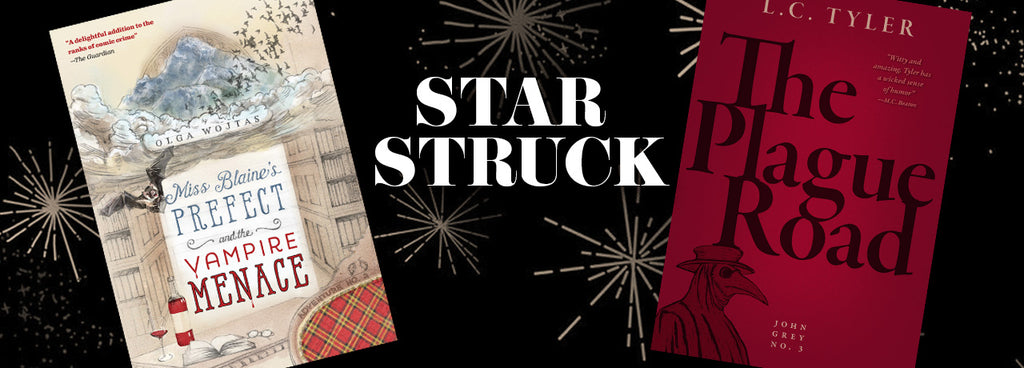
And I’m far from the only member of Team Herring: We published the U.S. edition of The Herring-Seller’s Apprentice, the first in the series featuring Ethelred (a second-rate, sad-sack mystery writer) and Elsie (his superbly irritating agent), in 2009, and it was nominated for an Edgar award for best novel of the year in paperback original (more on Edgar awards in the blog). And the next year, just in case somebody had missed the message, the second book in the series, Ten Little Herrings, was nominated as well. And the year after that, Herring in the Library (that would be Herring #3) won England’s “Last Laugh” award, for the best funny mystery. You could say the books are pretty good.
Truly funny mysteries are very scarce (though sadly, mysteries by authors who think their books are funny, by authors who are trying very hard to be funny, are everywhere). For more from the truly and terrifically funny L.C. Tyler, please check back in a few weeks, when we’ll be posting our interview with him. For another gloriously funny series starring a lovable loser, try the “Charles Paris” series by Simon Brett (author of the “Blotto and Twinks” books), about an underemployed actor (with an agent who’s even worse than Elsie!). And if the awful Elsie has caught your fancy, you’ll enjoy Matricide at St. Martha’s, by Ruth Dudley Edwards, featuring the formidable (Miss) Jack Troutbeck.
Find out More
PAPERBACK [ $14.95 $10.95 ]
Add to Stack
Like many great mystery writers, Ms. Allingham began writing not because the muse was whispering into her shell-like ear, but because she had to pay the rent. And in the late 1920s, when she began publishing, the fashion in mysteries was for tales of “gentlemen-sleuths,” dinner-jackets at the ready, solving crimes as a form of sport. Albert Campion, who made his debut in 1929, would become one of the most beloved, quip-happiest, and longest-lived of the group: Ms. Allingham kept him detecting – and quipping – for nearly the next 40 years.
But what’s so fascinating about her career is the extent to which it spans a seemingly unspanable canyon between Mr. Campion’s essentially light-hearted adventures and the much darker, psychological suspense to which Ms. Allingham increasingly turned after World War II, by which point it had become a lot more difficult to view death as any kind of game. Of these novels, by far the best known is Tiger in the Smoke, which is widely regarded as one of the best mysteries of the 20th century. But for my money, Hide My Eyes – a chilling yarn about a psychopath and the aging woman who loves him – is as good and maybe even better. There’s a scene toward the end, where the two confront each other, all pretences stripped away…it will make your heart hurt, no matter how many times you read it, and I’ve read it more than once.
Mr. Campion barely gets a mention in the book, but fond though I am of the ever-quipping Albert, that scene more than makes up for his absence. And although this is nominally the 16th novel in the Campion series, you don’t need to have read the earlier books to enjoy it; just bring a love of language and a soul.
Extra Credit:
Fans of the witty Mr. Campion have both the excellent BBC series from the 1980s (“Campion,” available on DVD) and a gorgeous plenty of books to turn to – not only Mr. Campion’s many adventures but also the mysteries, certainly, of Dorothy L. Sayers, Edmund Crispin, and Elizabeth Daly, whose gentlemen-sleuths are beyond reproach (the last two, along with all the Campions, available from Felony & Mayhem). But if Hide My Eyes has intrigued you, you might well want to turn to Patricia Highsmith; The Talented Mr. Ripley came out just three years prior, and the two books are clearly cut from the same chilly psychological cloth. If the setting in post-war London has caught your attention, “The Ladykillers” (starring the ever-fabulous Alec Guinness, and available on DVD) will both give you both a sharp sense of what it looked like and a giggle besides. And if you can’t stop thinking about that deceptively charming, deadly young man (and wondering if perhaps you know anybody like him), pick up a copy of Jon Ronson’s non-fiction The Psychopath Test, which is funny and unnverving in pretty much equal measure.
Find out More
PAPERBACK [ $14.95 $10.95 ]
Add to Stack
When The Cambridge Theorem was first published, one reviewer called it a “cross between John le Carré and P.D. James,” and it’s that combo, a police procedural grafted onto a complex espionage yarn, that makes the book so swell. Fans of espionage (le Carré and Eric Ambler) will love it, as will fans of the kind of police procedurals (Pascoe and Dalziel, say) where the characters come jumping off the page. The two elements amplify each others’ best characteristics: The espionage angle (involving a man who may have been betraying England since the 1930s) gets twistier, with the kinds of switchbacks and betrayals that fans of spy fiction live for. And the cop at the center of the story? He’s a second-generation ‘tec with a passion for Willie Nelson, cowboy boots and the minutiae of the Kennedy assassination, as rude and vivid as a splash of paint on a gray stone wall. Oh, and if you’re looking for a present for your dad, the one who loves spooks and spies but has read everything in the field? Give him The Cambridge Theorem: you’ll make his day.
Nifty factoid: The Cambridge Theorem is rooted in the true story of the Cambridge Spies, a group of four – or was it five? – young men of extraordinary appeal and privilege, who met at one of the world’s great universities and spent several decades handing England’s (and America’s) secrets over to the Soviet Union. If you’d like to learn more about them, Anthony Blunt, by Miranda Carter; and Treason in the Blood, by Anthony Cave Brown, are two very well crafted biographies of the men at the center of the ring. “The Cambridge Spies” is a highly engaging BBC miniseries, available on DVD; and take a look at “Another Country” (with Rupert Everett and Cary Elwes, both inexcusably beautiful), a fictionalized biography of Guy Burgess, the most flamboyant member of the Cambridge Spies.
Find out More
PAPERBACK [ $14.95 ]
Add to Stack